Software development is a structured engineering process that involves much more than writing code. Building reliable software requires careful planning, requirement analysis, system architecture, development, testing, deployment, and continuous maintenance. Each activity contributes to the application's functionality, security, performance, and long-term reliability.
The SDLC software development life cycle provides a systematic framework for managing these activities. It establishes a defined process that guides software teams from the initial concept to the final product and its ongoing evolution. By following a structured development approach, organisations can improve project visibility, manage technical complexity, reduce development risks, and maintain consistent software quality.
As software systems become increasingly complex and interconnected, following a well-defined development process is essential. Modern SDLC practices also incorporate automation, continuous integration, cybersecurity, cloud infrastructure, and AI-assisted engineering to improve development efficiency and product reliability.
This guide explains what SDLC means, its different phases and models, the importance of secure software development, and the best practices organisations should follow to build maintainable and high-quality software.
What Is the SDLC Software Development Life Cycle?
The Software Development Life Cycle (SDLC) is a structured methodology used to plan, design, develop, test, deploy, and maintain software applications. It defines the activities, processes, and responsibilities involved in transforming software requirements into a functional product.
The primary objective of SDLC is to establish a consistent development process that ensures software meets defined business requirements, technical specifications, quality standards, and security expectations.
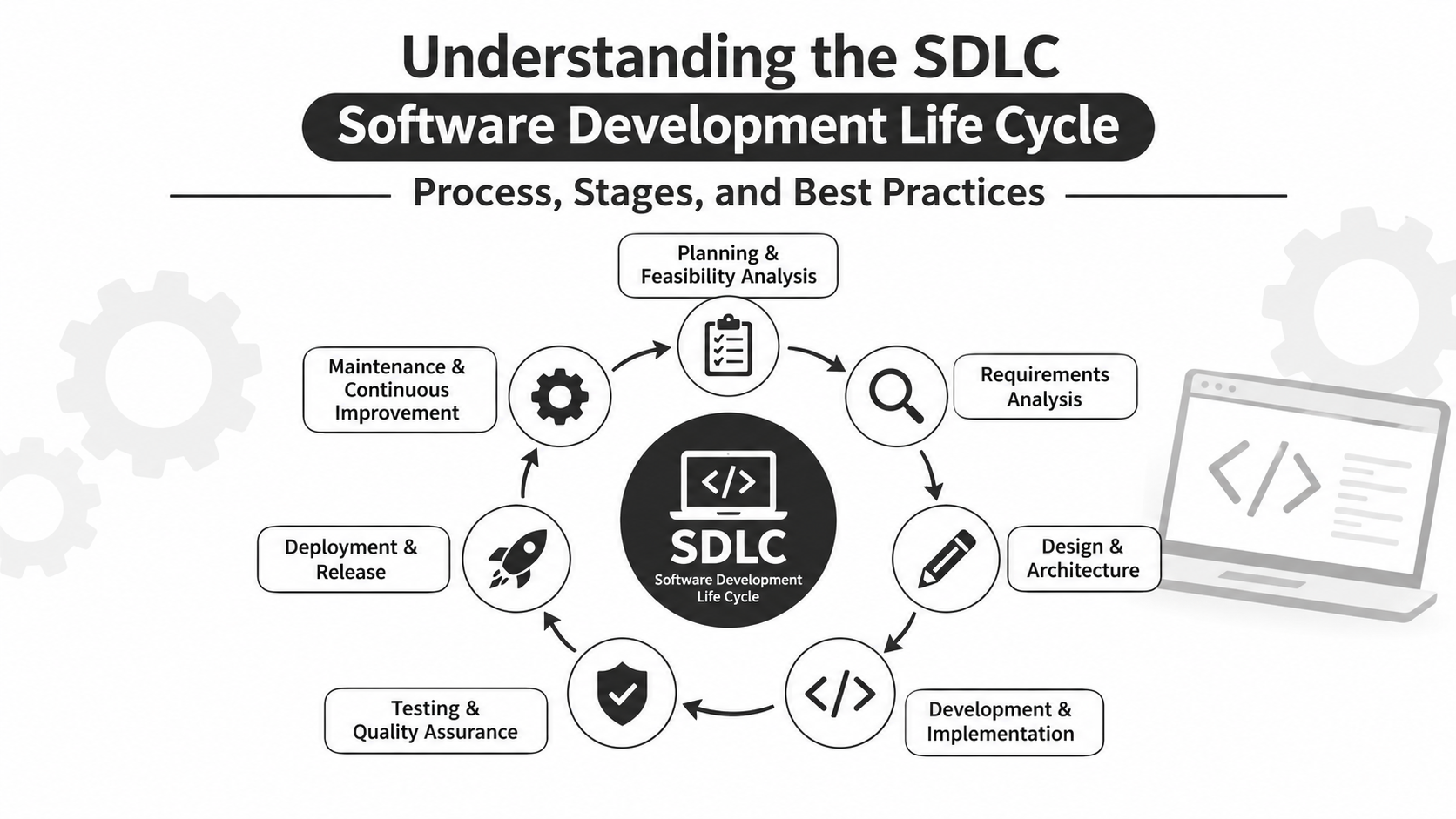
The software development life cycle generally consists of seven phases:
-
Planning and feasibility analysis
-
Requirements gathering and analysis
-
Software design and architecture
-
Software development and implementation
-
Testing and quality assurance
-
Deployment and release
-
Maintenance and continuous improvement
Although these phases provide a common foundation, their execution depends on the selected SDLC model. Some methodologies follow a sequential approach, while others organise development into iterative cycles with continuous feedback.
SDLC is not limited to the development stage. It covers the complete lifecycle of a software product, including the activities required to maintain its performance, security, compatibility, and functionality after release.
Why Is SDLC Important in Software Engineering?
The software development life cycle plays an important role in software engineering because it establishes a predictable and manageable approach to building software. Without a defined process, development activities can become difficult to coordinate, requirements may be misunderstood, and quality issues may remain undetected until late in the project.
A structured SDLC helps engineering teams maintain control over development activities while ensuring that technical decisions remain aligned with business objectives.
#1. Structured Project Management
SDLC divides software development into clearly defined phases, each with specific objectives, activities, and deliverables. This allows project managers and development teams to establish timelines, allocate resources, monitor progress, and coordinate responsibilities more effectively.
A structured workflow also improves communication between developers, designers, testers, business analysts, and stakeholders.
#2. Improved Software Quality
Software quality depends on more than the correctness of individual code components. It also involves functionality, performance, usability, compatibility, reliability, and maintainability.
SDLC incorporates quality assurance activities throughout development, helping teams identify defects, validate requirements, and maintain consistent engineering standards.
#3. Better Risk Management
Technical limitations, security vulnerabilities, changing requirements, and infrastructure dependencies can introduce risks during software development.
SDLC encourages teams to identify and assess these risks at appropriate stages. Early evaluation allows engineering teams to address potential problems before they become expensive or difficult to resolve.
#4. Cost and Time Efficiency
A well-defined development process helps minimise unnecessary rework, reduce project delays, and improve resource utilisation.
When requirements, architecture, and testing strategies are established early, teams can make informed decisions and avoid spending excessive time correcting preventable issues.
#5. Enhanced Security and Compliance
Security is an essential part of modern software engineering. SDLC provides opportunities to integrate security requirements, vulnerability assessments, access controls, and testing throughout the development process.
This becomes particularly important for applications handling sensitive information or operating in regulated environments.
#6. Long-Term Maintainability
Software requires continuous updates to remain compatible with changing technologies, user expectations, and business requirements.
SDLC encourages proper documentation, modular architecture, testing, and maintenance planning. These practices make applications easier to troubleshoot, extend, and improve throughout their operational life.
What Are the 7 Phases of the Software Development Life Cycle?
The software development life cycle consists of seven interconnected phases. Each phase addresses a specific part of the engineering process and contributes to the successful delivery of the final application.
Although the sequence may vary depending on the development methodology, the following phases represent the commonly followed SDLC structure.
#1. Planning and Feasibility Analysis
Planning is the foundation of the software development life cycle. Before development begins, organisations need to establish the purpose of the software, define its objectives, evaluate project requirements, and determine whether the proposed solution is feasible.
This phase involves collaboration between stakeholders, project managers, business analysts, architects, and technical teams to establish a shared understanding of the project.
The planning process generally includes:
Defining project objectives: Establishing the business problem, expected outcomes, project scope, and measurable goals.
Estimating resources: Determining the development team, infrastructure, technologies, tools, and financial resources required.
Evaluating feasibility: Assessing whether the proposed solution can be developed and operated within the available technical, financial, and operational constraints.
Identifying risks: Evaluating potential challenges related to technology, security, resources, dependencies, and project timelines.
Establishing project timelines: Defining milestones, deliverables, responsibilities, and expected completion periods.
Feasibility analysis is particularly important because it helps determine whether the project is practical before significant development resources are committed.
The main outcome of this phase is a project plan that defines the scope, objectives, estimated costs, resources, risks, and overall development direction.
#2. Requirements Gathering and Analysis
Requirements analysis translates business objectives into clearly defined technical and functional specifications.
This phase focuses on understanding what the software must accomplish, how users will interact with it, and what operational standards it must satisfy.
Requirements are generally classified into two categories.
Functional Requirements
Functional requirements describe the specific operations, features, and behaviours that a software system must support. They define the expected functionality of the application and the interactions between its components and users.
These requirements may cover authentication, data processing, user permissions, reporting, integrations, notifications, and business workflows.
Non-Functional Requirements
Non-functional requirements define the quality attributes and operational expectations of the software. They determine how effectively the application should perform under different conditions.
Important non-functional requirements include:
-
Performance and response time.
-
Application availability and reliability.
-
Security and data privacy.
-
Scalability and resource utilisation.
-
Usability and accessibility.
-
Compatibility and interoperability.
-
Maintainability and extensibility.
Requirements analysis also involves identifying dependencies, resolving conflicting expectations, prioritising features, and validating technical constraints.
The Software Requirements Specification (SRS) document is commonly used to record these requirements. It provides a reference for architects, developers, testers, and stakeholders throughout the project.
Accurate requirements analysis is essential because incomplete or ambiguous specifications can lead to incorrect implementations, increased development costs, and extensive modifications during later stages.
#3. Software Design and Architecture
The software design and architecture phase converts approved requirements into a technical blueprint for implementation.
It defines how the system will be structured, how individual components will communicate, how information will be stored, and how the application will satisfy its functional and non-functional requirements.
Software design generally involves two levels.
High-Level Design (HLD)
High-Level Design defines the overall system architecture and major technical components. It describes the architectural pattern, technology stack, infrastructure, database systems, integrations, and communication mechanisms.
This phase also considers architectural decisions related to modularity, system boundaries, deployment environments, and data management.
Low-Level Design (LLD)
Low-Level Design focuses on the internal implementation of individual components. It describes module-level logic, API specifications, database relationships, data structures, algorithms, interfaces, and interactions between software components.
An effective design process must also consider several important engineering principles:
-
Modularity: Dividing software into independent components with clearly defined responsibilities.
-
Maintainability: Ensuring the system can be modified and updated without introducing unnecessary complexity.
-
Reliability: Designing components to operate consistently and handle failures appropriately.
-
Performance: Considering response times, resource consumption, and system efficiency.
-
Security: Incorporating authentication, authorisation, encryption, and secure communication.
-
Interoperability: Ensuring different systems and services can communicate effectively.
Architecture decisions made during this phase have a long-term impact on application performance, development complexity, operational costs, and future enhancements.
A well-designed architecture provides a strong technical foundation for the development and maintenance stages.
#4. Software Development and Implementation
Software development is the implementation phase in which the approved design and technical specifications are translated into executable code.
Developers build application components, implement business logic, configure databases, integrate external services, and establish communication between different system modules.
This phase requires consistent engineering practices to ensure that the codebase remains reliable, understandable, and maintainable.
Important development activities include:
Frontend Development: Building the user interface and implementing interactions that allow users to access application functionality.
Backend Development: Developing server-side logic, business processes, APIs, authentication mechanisms, and data processing operations.
Database Development: Designing database schemas, defining relationships, managing queries, and implementing appropriate data access mechanisms.
API Integration: Establishing communication between internal services, external platforms, and third-party applications.
Version Control: Managing code changes, development branches, collaboration, and revision history through version control systems.
Code Reviews: Reviewing implementation quality, identifying potential defects, and ensuring compliance with established coding standards.
Modern development teams also use continuous integration practices to validate code changes as they are introduced into the shared codebase.
Development standards, automated checks, and technical documentation help maintain consistency across the project and reduce the complexity of future maintenance.
#5. Software Testing and Quality Assurance
Software testing and quality assurance verify whether the developed application meets its defined requirements and performs as expected.
This phase evaluates application functionality, reliability, performance, security, compatibility, and usability. Its objective is to identify defects and weaknesses before the software is released into the production environment.
Software testing involves several specialised approaches.
Unit Testing: Validates individual functions, methods, and components to ensure that they behave as expected.
Integration Testing: Checks whether connected modules, services, databases, and APIs communicate and exchange information correctly.
System Testing: Evaluates the complete application against its functional and non-functional requirements.
Functional Testing: Verifies that application features perform their intended operations.
Performance Testing: Measures application response time, throughput, stability, and behaviour under different workloads.
Security Testing: Identifies vulnerabilities, insecure configurations, access control weaknesses, and potential attack vectors.
Regression Testing: Ensures that new modifications do not negatively affect previously working functionality.
User Acceptance Testing (UAT): Validates whether the application meets business requirements and is suitable for its intended users.
Testing should not be restricted to the final stages of development. Modern engineering practices encourage continuous testing, allowing defects to be detected closer to the point where they are introduced.
Automation also plays an important role in quality assurance. Automated test suites can repeatedly validate application functionality, while continuous integration pipelines help prevent defective code from progressing through the development workflow.
A comprehensive testing strategy improves software reliability and reduces the operational risks associated with production releases.
#6. Software Deployment and Release
Deployment is the phase in which the tested and approved software is released into its intended production environment.
It involves preparing infrastructure, configuring application services, managing environment-specific settings, and making the software accessible to its intended users.
Deployment activities typically include:
-
Production environment configuration.
-
Database provisioning and migration.
-
Application build and release management.
-
Domain, networking, and SSL/TLS configuration.
-
Access permissions and security configuration.
-
CI/CD pipeline execution.
-
Application health checks and monitoring.
Software deployment can follow different release strategies depending on application architecture, availability requirements, and operational risk.
Continuous Deployment: Automatically releases code changes to production after they pass the required automated validation processes.
Blue-Green Deployment: Uses two production environments to reduce deployment-related downtime and provide a controlled release process.
Rolling Deployment: Gradually replaces application instances with updated versions rather than updating the entire environment simultaneously.
Canary Deployment: Releases new software to a limited portion of users or infrastructure before expanding availability.
A successful deployment requires more than transferring application code to a server. Teams must also validate production configurations, monitor system behaviour, verify integrations, and establish rollback procedures.
Proper release management helps minimise service disruptions and maintain application availability.
#7. Software Maintenance and Continuous Improvement
Software maintenance is the final phase of the SDLC, but it represents an ongoing responsibility throughout the operational life of an application.
After deployment, software must be monitored, maintained, and updated to address defects, security vulnerabilities, changing technologies, and evolving business requirements.
Software maintenance is generally divided into four categories.
- Corrective Maintenance: Focuses on identifying and fixing defects that affect application functionality or performance after deployment.
- Adaptive Maintenance: Involves modifying software to maintain compatibility with updated operating systems, hardware, frameworks, infrastructure, and regulatory requirements.
- Perfective Maintenance: Improves existing functionality, application performance, usability, and overall system efficiency based on changing needs.
- Preventive Maintenance: Addresses potential weaknesses and technical issues before they develop into major operational problems.
Maintenance activities also include database optimisation, dependency updates, infrastructure monitoring, backup management, security patching, and technical documentation updates.
Continuous monitoring provides valuable information about application health, resource consumption, errors, and operational performance. This information helps engineering teams identify issues and prioritise improvements.
The maintenance phase ensures that software remains secure, reliable, compatible, and useful beyond its initial release.
What Are the Different Types of SDLC Models?
An SDLC model defines how the different phases of software development are organised, executed, and managed.
While the fundamental objective remains the same, different models use different approaches to project planning, development, testing, and delivery.
Selecting the appropriate model depends on project complexity, requirement stability, risk levels, stakeholder involvement, and delivery expectations.
#1. Waterfall Model
The Waterfall model follows a sequential approach in which software development progresses through predefined phases.
Each phase is generally completed and reviewed before the next phase begins. Requirements, design, implementation, testing, deployment, and maintenance follow an established sequence.
This model emphasises detailed documentation, structured planning, and clearly defined project milestones.
Its primary advantage is predictability. Teams can establish development activities, responsibilities, and deliverables early in the project.
However, the sequential nature of Waterfall makes significant changes more difficult to accommodate once development has progressed. It is therefore more suitable for projects where requirements are stable and clearly understood.
#2. Agile Model
Agile is an iterative and incremental software development approach that emphasises collaboration, adaptability, continuous feedback, and frequent delivery.
Instead of completing the entire development process in one sequence, teams divide work into smaller iterations, commonly organised into sprints.
Each iteration involves planning, development, testing, review, and feedback. This allows teams to improve functionality progressively and respond to changing requirements.
Agile methodologies also encourage close collaboration between developers, product owners, stakeholders, and quality assurance teams.
Scrum and Kanban are widely used frameworks for implementing Agile principles.
Agile is particularly useful when requirements evolve throughout development or when frequent releases and continuous stakeholder feedback are important.
#3. Iterative Model
The Iterative model develops software through repeated development cycles.
Rather than attempting to deliver the complete application in a single development phase, teams create an initial version and refine it through successive iterations.
Each iteration involves planning, design, implementation, testing, and evaluation.
This approach allows technical issues and requirement gaps to be identified progressively. It also provides opportunities to improve software architecture and functionality as development continues.
The Iterative model is useful when requirements are not completely defined at the beginning but can be progressively clarified.
#4. Spiral Model
The Spiral model combines iterative development with systematic risk analysis.
Software development progresses through multiple cycles, with each cycle focusing on planning, risk evaluation, engineering, and stakeholder assessment.
Risk analysis is a central part of this methodology. Before proceeding with development activities, teams identify potential technical, financial, operational, and security risks.
This approach allows organisations to address high-risk areas early and make informed decisions throughout the project.
The Spiral model is particularly suitable for large, complex, and high-risk software systems. However, its extensive risk assessment and management activities can increase project costs and require specialised expertise.
#5. V-Model
The V-Model, also known as the Verification and Validation Model, is a structured SDLC methodology that connects development activities with corresponding testing activities.
The left side of the V represents requirements analysis and design, while the right side represents the associated testing and validation processes.
Each development stage has a corresponding testing stage, ensuring that quality considerations are established early rather than introduced only after implementation.
The V-Model emphasises documentation, traceability, and systematic verification.
It is suitable for software projects that require strict quality assurance, clearly defined requirements, and formal validation processes.
#6. DevOps Model
DevOps combines software development and IT operations through collaboration, automation, continuous integration, continuous delivery, and ongoing monitoring.
Traditional development workflows often separate software creation from deployment and operational management. DevOps reduces these divisions by establishing a continuous engineering and delivery process.
Its core practices include:
-
Continuous Integration (CI).
-
Continuous Delivery and Deployment (CD).
-
Infrastructure as Code (IaC).
-
Automated testing.
-
Configuration management.
-
Infrastructure monitoring.
-
Continuous feedback and improvement.
DevOps helps organisations improve release consistency, reduce manual deployment activities, and respond more quickly to operational issues.
It is especially valuable for software products that require frequent updates, reliable releases, and continuous infrastructure management.
What Is the Secure Software Development Life Cycle (Secure SDLC)?
The Secure Software Development Life Cycle (Secure SDLC) is an approach that integrates security practices into every stage of software development.
Instead of treating cybersecurity as a final testing activity, Secure SDLC makes security an ongoing engineering responsibility from initial planning to post-deployment maintenance.
This approach is important because vulnerabilities can originate at different points in the development process. Inadequate requirements, insecure architecture, coding weaknesses, vulnerable dependencies, and incorrect production configurations can all introduce security risks.
Secure SDLC aims to identify and address these weaknesses before they affect the application or its users.
#Key Practices of Secure SDLC
1. Security Requirements and Risk Assessment
Security requirements should be defined during the initial planning and requirements phases. Teams need to identify data protection requirements, authentication standards, access control policies, compliance obligations, and potential threats.
2. Threat Modelling
Threat modelling evaluates the application's architecture, data flows, trust boundaries, and potential attack surfaces. It helps engineering teams identify security weaknesses and prioritise appropriate mitigation measures.
3. Secure Software Architecture
Security should influence architectural decisions, including system boundaries, identity management, encryption, network communication, data storage, and service permissions.
Principles such as least privilege, defence in depth, and secure-by-design architecture help reduce exposure to potential attacks.
4. Secure Coding Practices
Developers should follow secure coding standards to prevent common vulnerabilities such as SQL injection, cross-site scripting, insecure deserialisation, and improper input validation.
Code reviews and automated security checks further strengthen implementation quality.
5. Dependency and Vulnerability Management
Third-party libraries, frameworks, packages, and external services can introduce security vulnerabilities.
Software composition analysis (SCA), dependency scanning, and regular package updates help teams identify and manage these risks.
6. Security Testing
Security testing should be integrated into the development and testing workflow.
Common approaches include:
-
Static Application Security Testing (SAST).
-
Dynamic Application Security Testing (DAST).
-
Software Composition Analysis (SCA).
-
Infrastructure security assessments.
-
Penetration testing.
-
Configuration and access control reviews.
These techniques help identify vulnerabilities across source code, running applications, dependencies, and infrastructure.
7. Secure Deployment and Continuous Monitoring
Production environments should follow secure configuration standards, restricted access policies, encryption requirements, and appropriate secrets management practices.
After deployment, monitoring systems should track suspicious activities, application errors, access events, and security alerts.
Secure SDLC is an ongoing process rather than a one-time security assessment. It helps organisations improve software resilience while reducing the risks associated with insecure development practices.
The NIST Secure Software Development Framework (SSDF) and OWASP Software Assurance Maturity Model (SAMM) provide established guidance for incorporating security into software engineering processes.
Common Challenges in the Software Development Life Cycle
Although SDLC provides a structured approach to software development, implementing it effectively can involve several challenges. Understanding these challenges helps organisations establish appropriate processes and reduce development risks.
- Changing Requirements: Frequent changes in business objectives or stakeholder expectations can affect project scope, architecture, timelines, and resource allocation. Without a structured change management process, requirement changes may introduce inconsistencies and unnecessary development work.
- Communication Gaps: Software projects involve multiple teams with different responsibilities and technical perspectives. Poor communication can create misunderstandings, delays, and inconsistent implementation decisions. Clear documentation, regular reviews, and defined communication channels help address this challenge.
- Technical Debt: Technical debt develops when short-term implementation decisions create additional maintenance or engineering work in the future. It can result from rushed development, outdated dependencies, insufficient testing, or poor architectural decisions. Regular refactoring, code reviews, and architecture improvements help control technical debt.
- Security Vulnerabilities: Applications may contain vulnerabilities introduced through insecure code, outdated dependencies, incorrect configurations, or insufficient access controls. Security must therefore remain part of the complete development process, supported by automated checks, testing, and continuous monitoring.
- Integration Complexity: Modern software systems frequently depend on APIs, external platforms, databases, cloud services, and third-party components. Integration issues can affect application functionality, data consistency, and overall reliability. Well-defined API contracts, integration testing, and appropriate error-handling mechanisms help reduce these risks.
- Performance and Scalability Issues: Applications must be designed to handle expected workloads while maintaining acceptable response times and resource utilisation. Insufficient performance testing and inadequate architectural planning can create bottlenecks as usage increases. Performance evaluation and infrastructure monitoring should be incorporated into development and maintenance activities.
#Conclusion
The SDLC software development life cycle provides the foundation for planning, designing, developing, testing, deploying, and maintaining reliable software applications. Each phase contributes to the overall success of a software product. Requirements analysis establishes what needs to be built, architecture defines how the system will function, development implements its capabilities, and testing validates its quality. Deployment makes the application available, while maintenance ensures its continued reliability and relevance.
Choosing the right SDLC model, following secure development practices, maintaining technical documentation, and adopting automation can significantly improve software delivery. A well-implemented software development life cycle enables businesses to build dependable digital products that meet current requirements while remaining adaptable to future technological and operational changes.