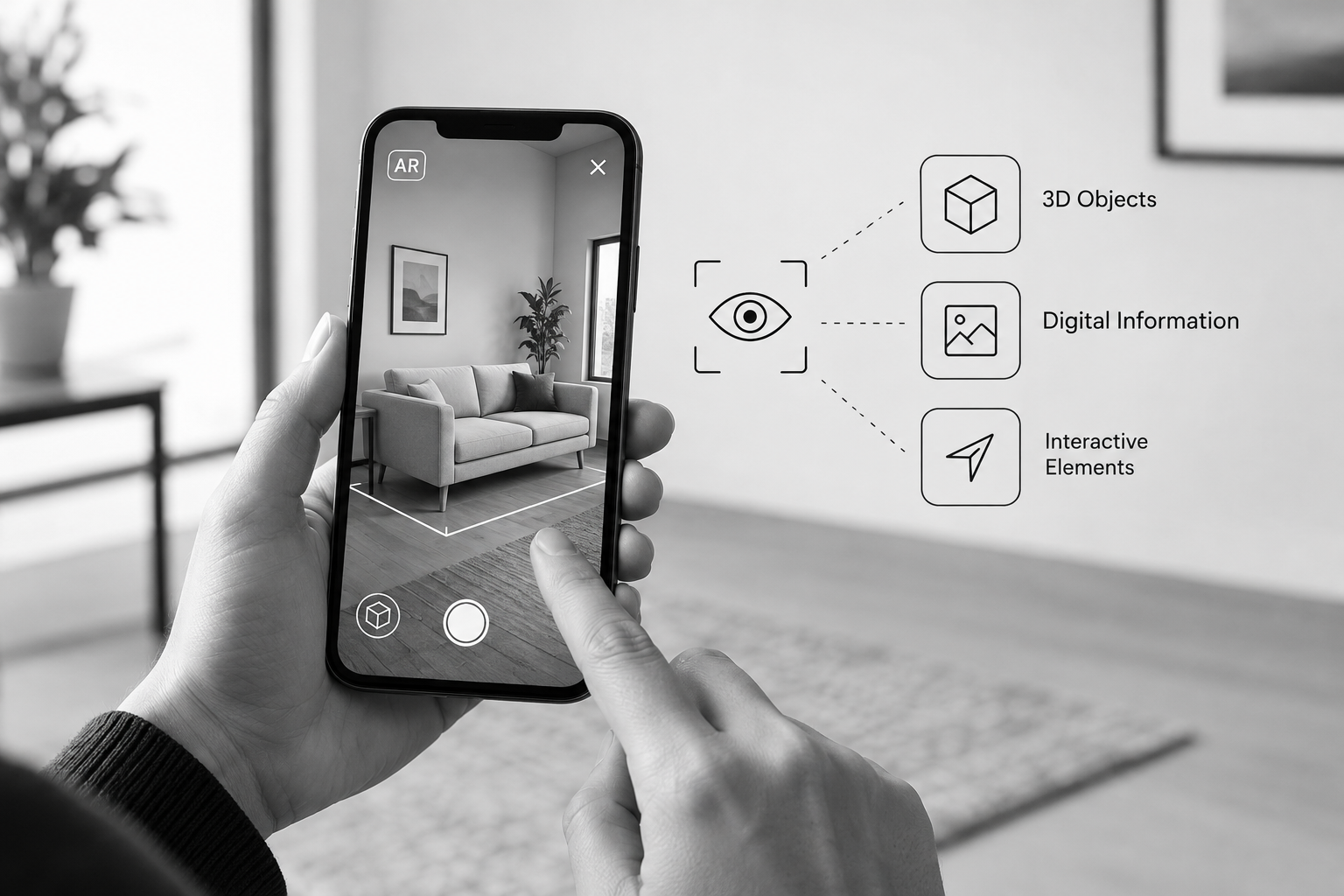
Augmented reality is changing how people interact with digital information in the real world. From trying furniture in a room before purchasing it to learning complex procedures through interactive demonstrations, augmented reality is making everyday experiences more engaging and informative.
Businesses, educators, healthcare professionals, and manufacturers are increasingly exploring AR technology to improve customer experiences, simplify tasks, and support practical learning.
But what is augmented reality, how does it work, and where can it be used? This guide explains the fundamentals of AR, its applications, benefits, and role in training.
What Is Augmented Reality?
Augmented reality (AR) is a technology that overlays digital content, such as images, text, animations, 3D models, and interactive elements, onto a person's view of the physical world. It enhances the real environment rather than replacing it entirely.
AR experiences can be accessed through smartphones, tablets, smart glasses, and specialized headsets. For example, a person can point their smartphone at an empty room and see a virtual sofa positioned within the space. The furniture is digital, but the room remains real.
Unlike technologies that create entirely virtual environments, augmented reality combines physical surroundings with computer-generated elements. This allows users to interact with digital information while remaining connected to their actual environment.
#What Does Augmented Reality Mean?
The meaning of augmented reality becomes clearer when we break down the term itself.
-
Augmented: Something that is enhanced, expanded, or improved.
-
Reality: The physical world around us.
Together, augmented reality means enhancing the real world with digital information or computer-generated content.
For example, navigation applications can display directional arrows over a live camera view, helping users understand where to turn. Similarly, AR shopping applications can show how a product might look in a user's home before they buy it.
The purpose of augmented reality is to make information more accessible, visual, and interactive in real-world situations.
How Does Augmented Reality Work?
Augmented reality works by combining camera input, sensors, software, and digital content to create an experience that connects virtual objects with the physical environment.
Although the technology varies across applications, most AR systems follow a few fundamental steps.
#1. Capturing the Real Environment
An AR-enabled device uses a camera, motion sensors, and other available hardware to understand the user's surroundings. The camera captures images or video, while sensors help determine the device's position and movement.
#2. Understanding the Environment
AR software processes the collected information to identify surfaces, objects, spatial features, or visual markers. Depending on the application, it may recognize a flat surface, track a specific image, or estimate the distance between objects.
#3. Placing Digital Content
Once the environment is understood, the software positions digital elements within the user's view. These elements might include 3D product models, instructional labels, animated characters, or navigation indicators.
#4. Displaying the Augmented Experience
The device combines the real-world camera view with digital content and displays the result on the screen or through compatible AR glasses. As the user moves, the software updates the position of virtual objects to maintain the effect.
#5. Supporting Interaction
Some AR applications allow users to rotate 3D models, select digital objects, follow instructions, or trigger animations. These interactions make the experience more useful than simply viewing an image on a screen.
Modern AR systems may also use artificial intelligence and computer vision to recognize objects, interpret scenes, and deliver context-specific information.
Types of Augmented Reality
Different AR technologies support different use cases. The most suitable approach depends on the environment, hardware, and experience a business wants to create.
#Marker-Based AR
Marker-based AR uses a recognizable image, symbol, or visual pattern to trigger digital content. When a device's camera detects the marker, the application displays related information or animations.
Example: A printed product brochure that reveals a 3D product demonstration when scanned.
#Markerless AR
Markerless AR does not require a predefined image to activate the experience. Instead, it uses technologies such as motion tracking, environmental understanding, and spatial mapping to place virtual objects in the real world.
Example: An application that lets users position virtual furniture anywhere on their floor.
#Location-Based AR
Location-based AR uses geographical information, GPS, and other positioning technologies to deliver digital content based on a user's location.
Example: An application that displays points of interest, historical information, or directions when users explore a city.
#Projection-Based AR
Projection-based AR projects digital images or visual instructions onto physical surfaces. Depending on the system, projected elements may respond to user actions or changes in the environment.
Example: Projected assembly instructions that guide workers through a manufacturing process.
What Are the Applications of Augmented Reality?
Augmented reality has applications across industries because it can present digital information directly within real-world contexts.
#Retail and E-commerce
Retailers use AR to help customers visualize products before making a purchase. Shoppers can preview furniture in their homes, experiment with virtual makeup, or see how certain products might look in a particular setting.
These experiences can help customers make more informed purchasing decisions.
#Education
AR can make learning more interactive by turning abstract concepts into visual experiences. Students can explore 3D models of the human body, examine historical structures, or interact with representations of scientific processes.
#Healthcare
Healthcare professionals can use AR-supported applications for medical education, anatomical visualization, procedural guidance, and selected clinical workflows. Actual applications depend on the system's capabilities, validation, and clinical requirements.
#Manufacturing and Maintenance
Industrial teams can access digital instructions, equipment information, and visual guidance while working with physical machinery. AR can help technicians identify components and follow maintenance procedures more consistently.
#Real Estate and Architecture
Architects and property professionals can use AR to visualize proposed layouts, furniture arrangements, and design elements within existing spaces. This makes it easier to communicate design ideas before construction or renovation begins.
#Gaming and Entertainment
AR games combine digital characters, objects, and interactive elements with physical surroundings. This creates experiences that encourage users to explore and interact with their environment.
What Is Augmented Reality Training?
Augmented reality training is a learning method that uses AR technology to display digital instructions, 3D models, animations, and interactive guidance within a real-world environment.
Instead of relying exclusively on written manuals, videos, or classroom explanations, learners can see relevant information while performing a task or practicing a procedure.
For example, a maintenance technician learning to service industrial equipment could use an AR application that highlights individual components and displays the steps required to inspect them.
#How Does AR Training Work?
An AR training program typically begins with a defined learning objective and a practical task. Developers then create digital instructions or 3D content that can be displayed through a smartphone, tablet, or compatible headset.
During the training session, learners follow visual prompts, examine virtual demonstrations, and complete tasks in a physical or simulated setting. Depending on the application, the system may also provide feedback or track progress.
#Benefits of Augmented Reality Training
-
Interactive learning: Learners can engage directly with visual content instead of relying entirely on passive instruction.
-
Practical demonstrations: Complex tasks can be broken into clear, visual steps.
-
Safer practice: Certain procedures can be rehearsed in controlled environments before learners work independently.
-
Consistent instruction: Standardized digital guidance helps organizations deliver repeatable training experiences.
-
On-the-job support: Employees may access instructions while carrying out real tasks, reducing the need to switch between equipment and separate reference materials.
AR training is particularly relevant to manufacturing, healthcare education, equipment maintenance, logistics, and technical skill development. Its effectiveness depends on the quality of the training design, the task being taught, and how well the technology fits the learners' needs.
What Is the Difference Between Augmented Reality and Virtual Reality?
Augmented reality and virtual reality are related technologies, but they provide different experiences.
| Feature | Augmented Reality (AR) | Virtual Reality (VR) |
|---|---|---|
| Environment | Combines the real world with digital content | Creates an immersive virtual environment |
| Real-world visibility | Usually remains visible | Typically replaced by the virtual environment |
| Common devices | Smartphones, tablets, AR glasses | VR headsets and controllers |
| Example | Viewing virtual furniture in a real room | Exploring a fully virtual architectural model |
| Typical uses | Product visualization, navigation, practical guidance | Simulations, immersive games, virtual training |
The right technology depends on the intended outcome. AR is useful when digital information needs to complement real surroundings, while VR is often suitable when users need a fully immersive environment.
Benefits and Challenges of Augmented Reality
Augmented reality can improve how people access information, visualize ideas, and perform practical tasks. However, implementing it successfully requires careful planning.
#Key Benefits
-
Better visualization: Users can examine digital representations in a real-world context.
-
More engaging experiences: Interactive content can encourage exploration and participation.
-
Contextual information: Digital instructions can appear where and when they are relevant.
-
Improved product understanding: Customers can preview products before purchasing.
-
Practical skill development: AR can support guided learning and task demonstrations.
#Common Challenges
-
Development costs: Creating accurate 3D models, interactions, and AR experiences may require specialized resources.
-
Device compatibility: Performance and available features vary across smartphones, tablets, and headsets.
-
Technical limitations: Lighting, tracking accuracy, and environmental conditions can affect the experience.
-
User adoption: Applications need intuitive interfaces and clear instructions.
-
Privacy and security: Camera access, spatial data, and connected systems must be handled responsibly.
Businesses should evaluate these factors before investing in an AR solution. A clear use case and a well-defined implementation plan can help ensure that the technology delivers practical value.
The Future of Augmented Reality
Augmented reality is evolving as mobile hardware, spatial computing, computer vision, and artificial intelligence continue to advance.
AI-powered AR applications can potentially recognize objects, interpret visual information, and provide more context-aware assistance. Meanwhile, improvements in AR glasses and spatial interfaces may make digital information easier to access without relying exclusively on smartphone screens.
For businesses, these developments create opportunities to improve product experiences, employee training, technical support, and customer engagement.
However, successful adoption will depend on solving practical challenges related to usability, affordability, accuracy, privacy, and integration with existing systems.
As businesses explore more intelligent digital experiences, enterprise AI solutions can help integrate AI capabilities into existing applications, business systems, and workflows.
Conclusion
Augmented reality enhances the physical world by adding interactive digital information to real environments. Understanding what augmented reality is, how it works, and what it can achieve helps businesses and individuals identify practical opportunities for using the technology.
From product visualization and education to industrial maintenance and augmented reality training, AR offers ways to make information more visual, accessible, and useful.
For organizations exploring AR adoption, the best starting point is to identify a specific problem, define the intended user experience, and determine whether an AR application can solve it effectively.