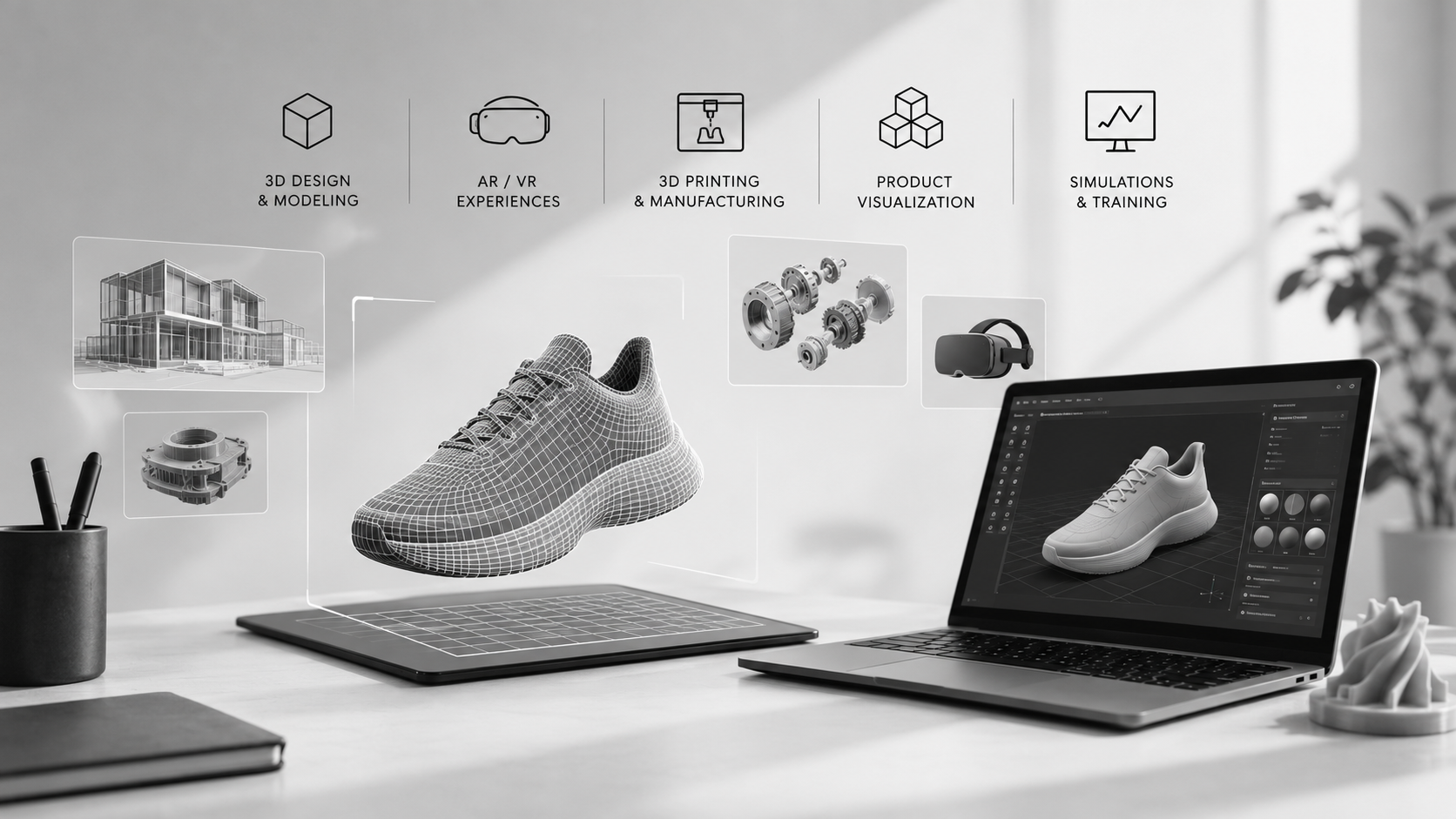
Technology is changing how businesses design products, present ideas, and interact with customers. From realistic digital models to interactive product demonstrations, 3D applications are creating new opportunities across industries. These technologies help organizations visualize complex concepts, improve workflows, and develop more engaging digital experiences.
As computing power improves and software becomes more accessible, three-dimensional technology is moving beyond specialist industries into everyday business operations. Companies can now use interactive visualizations, virtual product models, and digital environments to support decision-making, collaboration, and innovation.
In the coming years, advancements in artificial intelligence, augmented reality, virtual reality, and real-time rendering will expand the possibilities of 3D technology. Understanding these developments can help businesses identify practical opportunities and prepare for the next phase of digital transformation.
What Are 3D Applications?
Three-dimensional software allows users to create, view, modify, and interact with digital objects in a virtual environment. Unlike traditional two-dimensional interfaces, these tools represent depth, perspective, dimensions, and spatial relationships.
Businesses use this technology for product visualization, architectural planning, engineering simulations, entertainment, training, and interactive customer experiences. Depending on the intended purpose, a solution may run on a desktop computer, mobile device, web browser, or specialized headset.
For example, a furniture retailer can let customers examine a digital model of a sofa before purchasing it. An engineering team can inspect a component virtually before manufacturing a physical prototype. Similarly, educators can use interactive models to explain complicated scientific concepts.
The growing accessibility of 3D applications is making these capabilities relevant to businesses of different sizes, not just large technology companies.
How 3D Technology Is Transforming Business
#1. Product Design and Development
Product development often involves multiple design iterations, testing procedures, and communication between different teams. Three-dimensional models allow designers and engineers to evaluate shape, dimensions, materials, and functionality before production begins.
A digital representation can help teams identify design issues early, reducing unnecessary revisions and improving collaboration. Stakeholders can review a model, suggest changes, and understand the product more clearly than they might through flat drawings alone.
This approach is particularly valuable in automotive engineering, consumer electronics, industrial equipment, and furniture manufacturing. As simulation capabilities improve, businesses can also evaluate how products may perform under different operating conditions.
#2. Manufacturing and Industrial Innovation
Manufacturers are increasingly using digital models to improve production planning, equipment design, and quality control. Virtual representations can help teams examine production layouts, identify potential bottlenecks, and evaluate operational changes before implementing them.
In advanced manufacturing environments, digital twins can combine 3D representations with real-world sensor data. This enables organizations to monitor equipment, understand performance, and investigate potential problems.
The future of industrial visualization will likely involve closer integration between 3D models, automation systems, and artificial intelligence. These connected tools can help businesses make informed decisions while improving efficiency and reducing avoidable downtime.
#3. Marketing and Customer Experiences
Online customers cannot always evaluate a product as easily as they can in a physical store. Interactive visual experiences can bridge part of this gap by allowing users to rotate, zoom in on, and examine products from different angles.
Retailers can provide detailed previews of clothing, furniture, appliances, and other products. Realistic visualization may also help customers understand product dimensions, available configurations, and design options.
Businesses can use a 3d design application to prepare detailed product models for online catalogs, interactive presentations, and promotional campaigns. When these models are integrated into websites or mobile platforms, they can create more engaging shopping experiences.
#4. Education and Professional Training
Education is another area where three-dimensional technology offers significant potential. Students can explore anatomical structures, examine scientific models, or understand engineering concepts through interactive visual learning.
In professional training, realistic simulations can help employees practise procedures in controlled environments. Industries such as aviation, healthcare, construction, and manufacturing may use virtual scenarios to teach complex tasks without exposing learners to unnecessary real-world risks.
As these tools become easier to access, educational institutions and businesses may be able to deliver more personalized learning experiences. The combination of interactive models and intelligent learning systems could further improve how people understand difficult subjects.
#Why Businesses Are Exploring Additive Manufacturing
The applications of 3d printing are especially relevant when organizations need customization, rapid iteration, or geometries that are difficult to produce using conventional manufacturing methods.
However, printing is not automatically cheaper or faster for every product. Material costs, production volume, machine capabilities, finishing requirements, and quality standards all influence whether it is the right choice.
Businesses should evaluate the intended use case, technical requirements, and total production costs before adopting this technology. When applied appropriately, it can complement conventional manufacturing and support more flexible product development.
The Importance of 3D Graphics and Design Software
Behind every realistic digital environment is a combination of geometry, materials, lighting, rendering, and interaction. Improvements in these areas are making digital experiences more detailed and responsive.
#Real-Time Rendering and Interactive Experiences
A 3d computer graphics application can help professionals create visual assets, simulate lighting, build environments, and render objects for different digital platforms.
Real-time rendering allows scenes to respond quickly when users move objects, change viewpoints, or interact with virtual environments. This capability is important for product configurators, interactive websites, games, simulations, and virtual showrooms.
As graphics hardware and rendering techniques advance, businesses can deliver increasingly realistic experiences without relying exclusively on pre-rendered images or videos.
#Artificial Intelligence and Automated Workflows
Artificial intelligence is beginning to influence how digital assets are created and managed. AI-assisted tools can help generate initial models, suggest design variations, automate repetitive tasks, and support material or texture creation.
These capabilities may reduce the time required to move from an initial concept to a usable digital model. However, generated assets still need appropriate review for geometry, accuracy, usability, and technical compatibility.
For businesses, the greatest value may come from integrating AI into existing design and development workflows rather than treating it as a replacement for professional expertise.
Emerging Trends Shaping the Future of 3D Applications
#1. Integration With Augmented and Virtual Reality
Augmented reality can place digital objects within a view of the physical world, while virtual reality can immerse users in computer-generated environments. Together with interactive 3D models, these technologies can support product previews, remote collaboration, training, and virtual demonstrations.
For example, customers may preview furniture in their rooms before making a purchase. Architects may present proposed spaces through immersive walkthroughs, helping clients understand layouts and design decisions.
#2. Cloud-Based Collaboration
Cloud infrastructure is making it easier for distributed teams to access and review large digital assets. Instead of exchanging numerous files, teams can increasingly collaborate through shared projects, browser-based viewers, and centralized asset libraries.
A cloud-connected workflow can help designers, developers, manufacturers, and clients review changes from different locations. Security, access controls, file compatibility, and performance remain important considerations when choosing a platform.
#3. Web-Based 3D Experiences
Businesses are exploring ways to deliver interactive experiences directly through websites. Browser-based solutions can reduce the need for customers to install dedicated software, making product exploration more convenient.
As web graphics technologies improve, companies can incorporate interactive models into e-commerce stores, product pages, marketing campaigns, and online demonstrations.
The success of these experiences will depend on mobile compatibility, loading performance, accessibility, and how effectively the interaction supports the user's goal.
#4. Digital Twins and Predictive Analysis
Digital twins connect virtual representations of physical assets with relevant operational information. In suitable environments, these systems can help teams monitor equipment, examine performance, and simulate possible changes.
When combined with predictive analytics, digital twins may help organizations identify unusual patterns and plan maintenance more effectively. Their value depends on reliable data, appropriate models, and integration with existing business systems.
Challenges Businesses Should Consider
Despite their potential, three-dimensional technologies introduce practical challenges. Developing high-quality assets can require specialized expertise, suitable hardware, and significant production time. Complex models may also affect application performance, especially on lower-powered mobile devices.
Businesses should consider development costs, user requirements, platform compatibility, data security, and ongoing maintenance before investing. They should also establish clear performance goals, such as improving product understanding, shortening design cycles, or supporting employee training.
Starting with a defined business problem and a limited pilot project can help organizations test the technology before committing to a larger implementation.
For any consultation regarding any services visit us at - https://www.adrologic.com/contact
How Businesses Can Prepare for the Future
Organizations interested in adopting 3D technology should begin by identifying where spatial visualization can solve a real problem. The right solution will depend on the industry, intended users, available resources, and desired outcomes.
A practical approach includes:
- Define the objective: Identify whether the priority is product visualization, training, prototyping, or operational analysis.
- Choose the right platform: Evaluate desktop, mobile, web, AR, and VR options according to the use case.
- Plan digital assets: Determine how models will be created, optimized, stored, and updated.
- Test with real users: Gather feedback on usability, performance, and business value.
- Measure results: Track relevant indicators such as engagement, design revisions, task completion, or conversion rates.
Selecting a 3d design application should involve more than comparing visual features. Businesses should consider collaboration tools, export formats, integration capabilities, learning requirements, licensing, and long-term support.
#Conclusion
The future of three-dimensional technology will be shaped by its ability to solve practical problems across business and industry. From digital product experiences and advanced manufacturing to immersive training and intelligent simulations, these technologies are creating new ways to design, communicate, and innovate.
As AI, cloud computing, real-time graphics, and immersive interfaces continue to develop, organizations will have more opportunities to incorporate interactive visualization into their operations. Success, however, will depend on choosing appropriate use cases and delivering solutions that are useful, accessible, and technically reliable.
Businesses that evaluate these opportunities strategically can make better-informed technology decisions and prepare for a more interactive digital future.