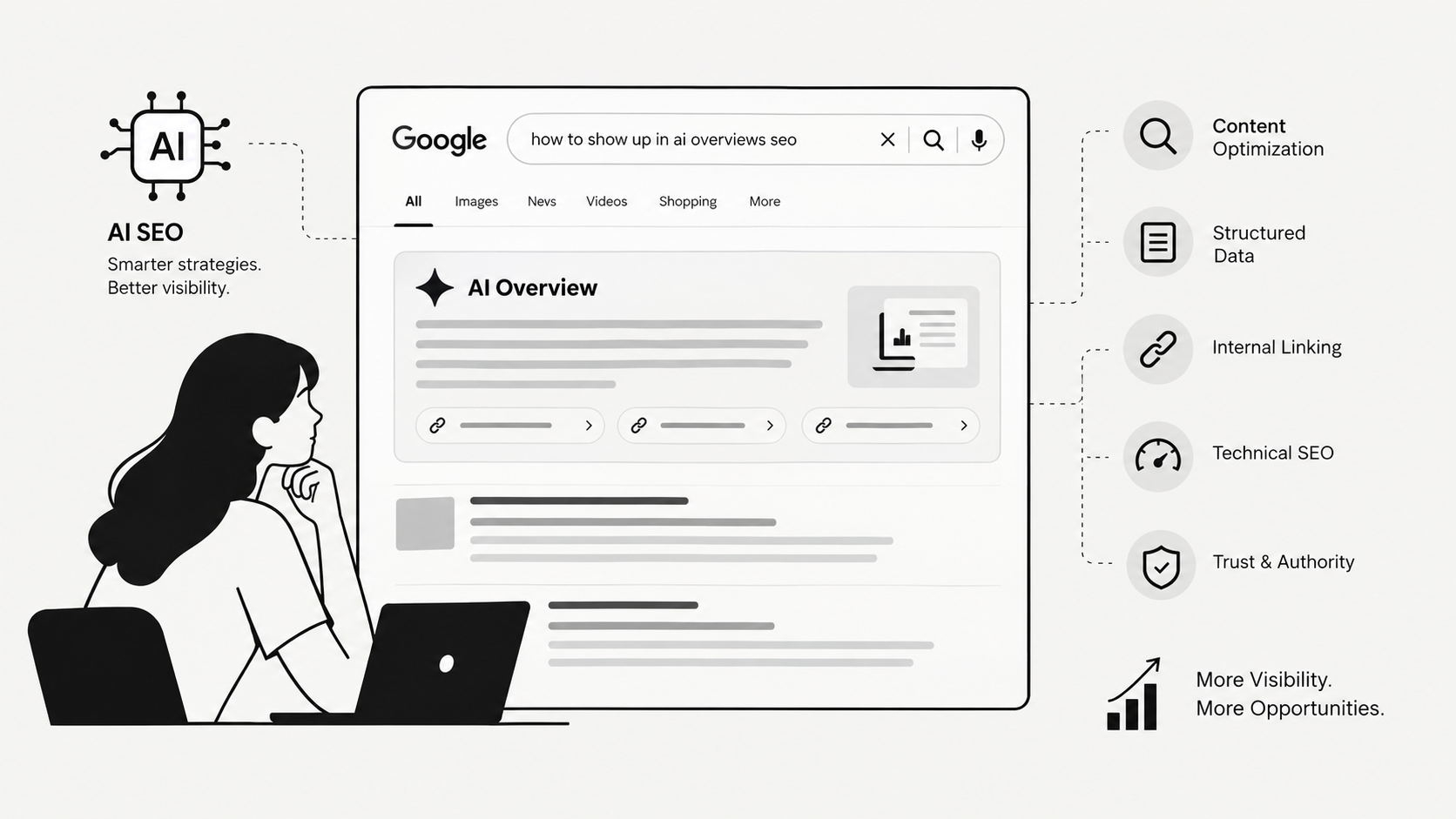
Search engines are evolving beyond traditional lists of blue links. Google AI Overviews provide AI-generated summaries that help users understand a topic, compare options, and find answers directly on the search results page. For businesses, this creates a new opportunity to reach potential customers, but it also raises an important question: how can a website appear in these AI-generated answers?
Understanding how to show up in AI Overviews requires a combination of traditional SEO fundamentals, helpful content, clear information architecture, and strong topical relevance. Although there is no guaranteed method to secure a mention in an AI Overview, websites can improve their eligibility by making their content useful, trustworthy, and easy for search engines to understand.
In this guide, we will explore practical optimization techniques, the role of AI in SEO, and how Google AI Overviews may influence organic search visibility.
What Are Google AI Overviews?
Google AI Overviews are AI-generated summaries displayed in Google Search for certain queries. They synthesize information from multiple sources and may include links to relevant webpages so users can explore a topic in greater detail.
Unlike traditional organic search results, which primarily display individual webpages, AI Overviews present a summarized response before or alongside other search results, depending on the query and search experience.
For example, a search for software development costs might produce an overview explaining the factors that influence pricing, such as project complexity, integrations, design requirements, and ongoing maintenance. The overview may also link to websites that provide useful information about those factors.
For businesses and publishers, being cited in an AI Overview can create another opportunity to introduce their expertise to searchers.
What Is AI SEO?
AI SEO refers to the use of artificial intelligence in search engine optimization and the broader practice of optimizing content for search experiences that incorporate AI-generated answers.
The term covers two related approaches.
First, marketers can use AI tools to support SEO activities such as keyword research, content analysis, search intent classification, content briefs, and technical issue detection.
Second, websites can optimize their content to improve its discoverability and usefulness in AI-powered search experiences, including Google AI Overviews.
However, AI SEO does not replace traditional SEO. Search engines still need to discover, crawl, index, and evaluate webpages. Relevant content, technical accessibility, useful internal links, and a positive user experience remain important foundations. For more info visit service page.
How to Show Up in Google AI Overviews
There is no guaranteed formula for appearing in Google AI Overviews. However, the following strategies can help search engines understand your content and make it more useful for users seeking answers.
#1. Answer Search Intent Directly
Start by understanding what users actually want to know when they search for a topic. Some queries require a short definition, while others call for a comparison, step-by-step explanation, or detailed buying guide.
Structure your content around that intent and answer the main question early in the page.
For example, if your target query is “how to show up in Google AI Overviews,” explain the core approach in the introduction rather than making readers navigate through several unrelated sections first.
You can then expand on the answer with supporting explanations, examples, practical recommendations, and relevant limitations.
This approach improves usability and makes the page's purpose clear to both readers and search engines.
#2. Create Helpful, Original, and Accurate Content
Content quality matters more than producing large volumes of AI-generated text. A page should contribute genuine value rather than repeat information already available across dozens of websites.
To strengthen your content:
-
Explain concepts using clear, specific language.
-
Include original examples, practical experience, or first-hand observations where relevant.
-
Support factual claims with reliable sources.
-
Keep statistics and time-sensitive information current.
-
Remove unnecessary introductions, repetitive paragraphs, and unsupported claims.
For example, instead of publishing a generic article about SEO automation, explain how a business could use automation to identify broken links, monitor indexation, or discover content gaps. Include the limitations and situations in which human review remains necessary.
Original insights give readers a reason to visit your website even when an AI-generated summary provides a quick answer.
#3. Structure Content With Clear Headings
A logical heading structure helps readers navigate a page and helps search engines interpret its sections.
Use one clear H1 for the main topic, followed by descriptive H2 headings for major sections and H3 headings for supporting points.
Use headings that accurately describe the content beneath them. Avoid repeating the same keyword in every heading simply to increase keyword frequency.
Short paragraphs, relevant examples, lists, and tables can also make complex information easier to understand. These formatting choices are primarily for usability; they do not independently guarantee AI Overview inclusion.
#4. Build Strong Topical Authority
A single article may answer one question, but a well-developed collection of related pages can demonstrate the breadth of your website's coverage.
Develop content around a clear subject area and connect related articles through contextual internal links.
For example, a website covering AI and software development might publish supporting content on:
-
AI SEO and AI-powered search
-
Generative AI applications for businesses
-
Enterprise AI solutions
-
Technical SEO and website performance
-
AI agents and business automation
Link these pages when doing so genuinely helps readers understand a related topic. Each page should have a distinct purpose rather than competing with several nearly identical articles.
Topical coverage can help search engines understand your site's subject matter, but publishing more articles alone does not guarantee rankings or citations.
#5. Demonstrate Experience, Expertise, and Trustworthiness
When content influences business decisions, readers need reasons to trust the information.
Make it clear who created or reviewed the content, provide relevant author information, and cite reliable references for important claims. Where appropriate, include original research, project examples, expert commentary, or documented methodologies.
For business websites, keep company information, contact details, service descriptions, and relevant case studies accurate and consistent.
Trust signals should reflect real expertise and verifiable information. Avoid fabricated author credentials, invented case studies, or claims that cannot be substantiated.
These practices support Google's broader emphasis on helpful, reliable, people-first content. They are not a separate checklist that guarantees selection in AI Overviews.
#6. Strengthen Technical SEO
Even excellent content has limited search value if search engines cannot access or index it properly.
Review the technical foundations of your website, including:
-
Indexability: Confirm that important pages are not unintentionally blocked by robots directives or
noindextags. -
Canonical tags: Use appropriate canonical URLs to consolidate duplicate or substantially similar pages.
-
Internal linking: Make important content accessible through relevant links from other pages.
-
Mobile usability: Ensure that pages work properly on mobile devices.
-
Page performance: Monitor Core Web Vitals and fix significant performance problems.
-
Structured data: Implement relevant, valid schema markup where it accurately describes the page.
An XML sitemap can help search engines discover important URLs, but submitting a sitemap does not guarantee indexing.
Likewise, structured data can clarify information about a page, organization, or product, but there is no special schema type that guarantees inclusion in Google AI Overviews.
#7. Use AI to Support Your SEO Workflow
AI tools can help SEO teams research topics, analyze content, identify patterns, and organize optimization tasks more efficiently.
Practical applications include:
Keyword clustering: Group related search queries by intent so you can plan pages around meaningful topics rather than isolated keywords.
Content gap analysis: Compare your existing coverage with the questions and subtopics users expect an article to address.
Content optimization: Identify vague explanations, missing examples, repetitive passages, and opportunities to improve readability.
Technical SEO analysis: Help interpret crawl exports, categorize common errors, and prioritize issues for manual investigation.
Content updates: Identify outdated statistics, broken references, and sections that need a fresh review.
AI-generated recommendations should be checked against reliable data and the actual website. AI can produce incorrect facts, misleading keyword suggestions, or technically invalid changes, so human review remains essential.
Most importantly, using AI to create content does not automatically improve rankings. The value comes from improving the quality, usefulness, and efficiency of the SEO process.
#8. Make Important Information Easy to Verify
When writing about a product, service, company, or technical subject, provide specific and consistent details.
For example, a software development company should clearly explain its services, capabilities, technologies, project approach, and relevant experience. A page that only makes broad claims such as “we deliver innovative digital solutions” offers little detail for readers trying to evaluate the business.
Use descriptive service pages, relevant case studies, clear definitions, and reliable references where appropriate.
When claims depend on conditions, explain those conditions rather than presenting an oversimplified answer. Accuracy and context are especially important for topics involving pricing, security, performance, and technical implementation.
This approach improves the quality of the information available to searchers and may make the content more useful as a supporting source in AI-generated answers.
#9. Measure AI Search Visibility
Traditional SEO reporting focuses on organic impressions, clicks, rankings, and conversions. These metrics remain important even as search experiences change.
To evaluate the impact of AI-powered search, monitor:
-
Organic impressions and clicks in Google Search Console.
-
Changes in rankings for important informational and commercial queries.
-
Organic traffic and conversions in your analytics platform.
-
Referral traffic from AI platforms where it can be identified.
-
Whether your brand or webpages appear in AI-generated search answers for a representative set of relevant queries.
AI Overview visibility can vary by query, location, device, language, and time. A page may also appear in traditional organic results without being cited in an AI Overview.
Record observations over time rather than drawing conclusions from one search. Use a consistent set of queries and locations, and distinguish confirmed observations from estimated visibility.
Google Search Console reporting does not necessarily provide a complete, separate view of every AI Overview appearance, so combine available reporting with carefully documented manual checks where appropriate.
How Will AI Overviews Change SEO?
Google AI Overviews are changing how users discover and consume information. Rather than clicking through several pages to understand a basic concept, searchers may receive a synthesized explanation directly in the results.
This creates several potential changes for SEO.
#More Competition for Attention
AI-generated summaries can occupy prominent space on the search results page. For some informational searches, users may find enough information without visiting a website.
As a result, impressions may not translate into clicks at the same rate for every query. The impact varies by topic, search layout, and user intent.
#Greater Importance of Distinctive Content
If several pages provide the same generic explanation, there may be little reason for a user to choose one over another.
Original research, useful tools, first-hand experience, detailed comparisons, and practical examples can give people a stronger reason to visit a source.
#A Broader View of Search Visibility
Ranking in traditional organic results is still valuable, but it is no longer the only search visibility opportunity businesses may want to monitor.
Mentions and links in AI-generated answers, branded searches, referral visits, and qualified conversions can provide additional context about how people discover a business.
#Continued Importance of SEO Fundamentals
AI-powered search does not eliminate the need for accessible, indexable, relevant, and useful web content. Technical SEO, sound information architecture, clear writing, and trustworthy information continue to form the foundation of search visibility.
The practical response is to strengthen these fundamentals while adapting content and measurement to evolving search experiences.
#How Is Google AI Overviews Going to Affect SEO Traffic?
The effect on traffic will depend on the type of search query and the role your page plays in answering it.
A simple informational query may be answered largely within the AI Overview, reducing the need for some users to click through. A complex question, product comparison, or service-related search may still encourage users to visit sources for more detail.
For businesses, the goal should not be to maximize visibility alone. It should be to attract relevant visitors who need the information, expertise, products, or services the website offers.
Consider separating your content into three broad categories:
-
Informational content: Definitions, explanations, and educational guides.
-
Consideration content: Comparisons, evaluations, implementation guides, and case studies.
-
Conversion content: Service pages, product pages, pricing information, and contact pages.
Evaluate each category using appropriate metrics. For example, educational content may help establish topical relevance and introduce a brand, while service pages may contribute more directly to qualified leads.
Do not assume that every AI Overview reduces traffic or that appearing in one guarantees additional visits. Measure the results for your own queries and pages.
#Common Mistakes to Avoid When Optimizing for AI Overviews
Several tactics can waste time or weaken content quality.
Keyword stuffing: Repeating “AI Overviews SEO” unnaturally does not make an article more useful.
Publishing large volumes of generic AI content: Content produced primarily to manipulate search rankings can fail to provide meaningful value.
Creating a separate page for every keyword variation: Closely related queries often share the same intent and may be better served by one comprehensive page.
Adding schema without a clear purpose: Structured data should describe real page content and follow the relevant technical guidelines.
Ignoring traditional SEO: A website should not abandon crawlability, indexation, internal linking, or content quality to chase emerging AI search trends.
Guaranteeing AI Overview rankings: No legitimate optimization method can promise that a particular webpage will appear in an AI-generated answer.
A sustainable strategy focuses on serving users well, maintaining technically sound pages, and measuring outcomes instead of relying on shortcuts.
#Conclusion
Learning how to show up in Google AI Overviews starts with the same principle that underpins effective SEO: create useful content that addresses real search needs and make it accessible to search engines.
Answer questions clearly, develop meaningful topical coverage, demonstrate genuine expertise, maintain strong technical SEO, and use AI tools to improve your workflow rather than replace editorial judgment.
As AI-powered search evolves, businesses that combine established SEO practices with original, trustworthy, and user-focused content will be better positioned to compete for visibility across changing search experiences. Although no strategy guarantees an AI Overview citation, a strong foundation gives your website a better opportunity to be discovered and considered by relevant audiences.