AI has moved beyond simple question-and-answer tools. Enterprises now use artificial intelligence to support customers, help employees find information, automate repetitive processes, and interact with business applications.
Two technologies often discussed together are AI chatbots and AI agents. Both can understand natural language and interact with users, but they are not designed to do exactly the same thing.
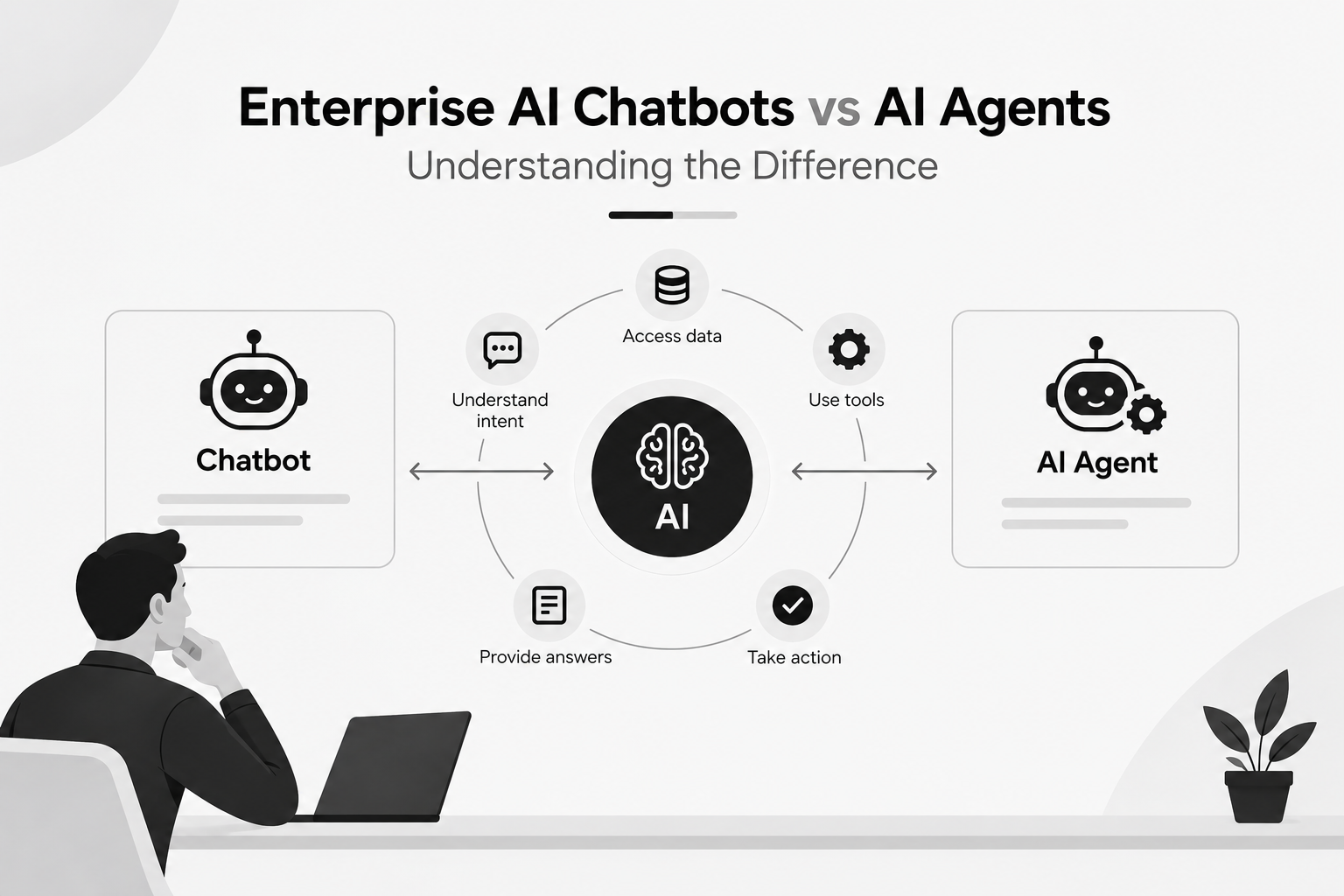
A chatbot is generally built around conversation. It answers questions, provides information, and assists users through a conversational interface. An AI agent can extend that interaction by using tools, accessing business systems, making decisions within defined boundaries, and carrying out multiple steps toward a specific objective.
So, how do you decide between the two? The answer depends on what you want the AI system to accomplish.
What Is an AI Chatbot?
An AI chatbot is a software system that uses artificial intelligence to communicate with users through natural language.
Traditional chatbots often relied on predefined rules and fixed responses. Modern AI chatbots can understand context, interpret different forms of a question, retrieve relevant information, and generate more natural responses.
For enterprises, this can make chatbots useful for customer service, employee support, product assistance, knowledge management, and internal help desks.
For example, an employee might ask:
"What is our remote-work policy?"
The chatbot can search an approved knowledge source and provide the relevant information.
The primary purpose is conversation and assistance. The chatbot helps the user obtain an answer or navigate information without necessarily carrying out a complex process.
What Is an AI Agent?
An AI agent is designed to do more than respond to a user. It can be given a goal and use available tools, data, and applications to work toward that goal.
For example, an employee might say:
"My laptop isn't connecting to the company network. Please help me resolve it."
An AI assistant could provide troubleshooting instructions.
An agent, depending on its implementation, could identify the employee, check device information, review previous support tickets, perform permitted diagnostic actions, create a support request, and notify the relevant team.
The important distinction is that the system is not only generating a response. It is participating in a workflow.
An agent's capabilities depend on its integrations, permissions, business rules, and level of human oversight. It should not automatically be assumed that every AI agent can independently perform every action.
#AI Agent vs Chatbot: What's the Difference?
The simplest way to understand the difference is to look at the role each system plays.
A chatbot is primarily designed to respond. An AI agent can be designed to respond, reason through a task, use tools, and take authorized actions.
For example, imagine a customer asks:
"Where is my order?"
A chatbot can retrieve the order status and tell the customer that the package is scheduled for delivery tomorrow.
An agent could potentially take the request further. If the shipment is delayed, it could check available options, communicate with the relevant system, initiate an approved support process, and update the customer.
This does not mean that chatbots can never perform actions. Modern conversational systems can connect to APIs and business applications. The distinction is more about the overall design and purpose of the system.
#Agentic AI vs Chatbot: What Actually Changes?
The difference becomes clearer when looking at what happens after the user makes a request. A conventional conversational experience usually follows a relatively simple pattern:
User request → AI understands → Information is retrieved → Response is generated
An agentic workflow can involve additional stages:
User request → AI understands the objective → Determines required steps → Uses tools → Interacts with systems → Completes actions → Reports the result
For example, consider a sales employee asking:
"Prepare a summary of our latest interaction with this client."
A chatbot could summarize information already provided or retrieved from an available source.
An agent could potentially access the CRM, retrieve recent interactions, review relevant records, identify outstanding activities, and produce a consolidated summary.
The difference is therefore not simply about how intelligent the conversation sounds. It is about whether the system is designed to perform work beyond the conversation.
#A Practical Enterprise Example
Customer support provides a useful example.
Suppose a customer says:
"I received the wrong product and want to return it."
#How a chatbot might handle it
The chatbot could explain the company's return policy, tell the customer what information is required, and provide instructions for starting the return.
This can be highly useful when the customer primarily needs information or guidance.
#How an AI agent might handle it
An agent could potentially identify the customer's order, verify the product, check whether the purchase qualifies for a return, access the relevant business rules, create a return request, update the customer record, and send confirmation.
The exact actions would depend on the integrations and permissions available to the system.
The difference is therefore visible in the workflow. The chatbot primarily guides the customer, while the agent can potentially participate in completing the process.
Where Enterprise AI Chatbots Make Sense
Chatbots can be a practical choice when the primary requirement is conversational assistance.
They can support:
-
Customer questions
-
Employee help desks
-
Product information
-
Frequently asked questions
-
Internal knowledge access
-
Basic troubleshooting
-
Document and policy discovery
For example, an organization could connect a chatbot to its internal knowledge base so employees can ask questions about company policies, technical documentation, onboarding procedures, or product information.
In these situations, the business may not need a system with extensive autonomous capabilities.
Where AI Agents Make Sense
Agents become more relevant when a process involves multiple steps, decisions, tools, or business applications.
An enterprise might explore agents for workflows such as customer onboarding, IT service management, sales operations, procurement, research, scheduling, or document processing.
Consider customer onboarding as an example.
Instead of simply explaining the onboarding process, an agent could potentially collect required information, validate data, interact with internal systems, identify missing information, prepare documentation, and route exceptions to a human employee.
The value comes from connecting AI with the actual workflow rather than keeping it limited to conversation.
Are AI Agents Always Better Than Chatbots?
No. The two technologies solve different problems.
If an organization needs an AI system primarily to answer questions, retrieve information, or provide conversational assistance, a chatbot may be sufficient.
If the organization needs AI to interact with multiple systems and complete multi-step tasks, an agent-based approach may be more appropriate.
Adding agent capabilities to a simple information-based use case can also introduce unnecessary complexity. More integrations, permissions, monitoring, and controls may be required.
The better approach is to start with the business problem and determine how much capability the workflow actually requires.
#Can Chatbots and AI Agents Work Together?
A chatbot can provide the user-facing conversational experience while an agent handles tasks behind the scenes. Both can complement each other together
For example:
User → Conversational interface → AI agent → Enterprise systems → Result
The conversational layer can understand the request and ask for clarification if necessary. The underlying agent can then check the order, verify whether the change is permitted, update the appropriate system, and return the result.
This architecture allows businesses to combine a simple conversational experience with more advanced workflow capabilities.
AI Agents vs Chatbots Difference: Which One Should You Choose?
The ai agents vs chatbots difference becomes easier to evaluate when the decision is based on the required outcome.
Choose a chatbot when the main requirement is: Conversation + information + assistance
Consider an AI agent when the requirement involves: Conversation + reasoning + tools + actions
And consider combining the two when users need a conversational interface that can also trigger complex business processes. Before implementation, enterprises should also evaluate data access, integrations, security, permissions, compliance, monitoring, human approval, and the potential impact of incorrect actions.
The objective should not be to give AI the maximum possible autonomy. It should be to give the system the right capabilities for the specific business process.
#Conclusion
AI chatbots and AI agents are closely related, but their roles within an enterprise can be different. A chatbot is primarily focused on conversation, information, and assistance. An AI agent can extend those capabilities into task execution, tool use, system interaction, and workflow automation.
For enterprises, the decision should not be based on which technology sounds more advanced. It should be based on the actual workflow, the systems involved, the actions required, and the level of control the organization needs.
In some cases, a chatbot is all that is required. In others, an AI agent can provide the additional capabilities needed to automate a complex process. And for more advanced enterprise applications, combining both can create a conversational experience that connects directly with business workflows.